
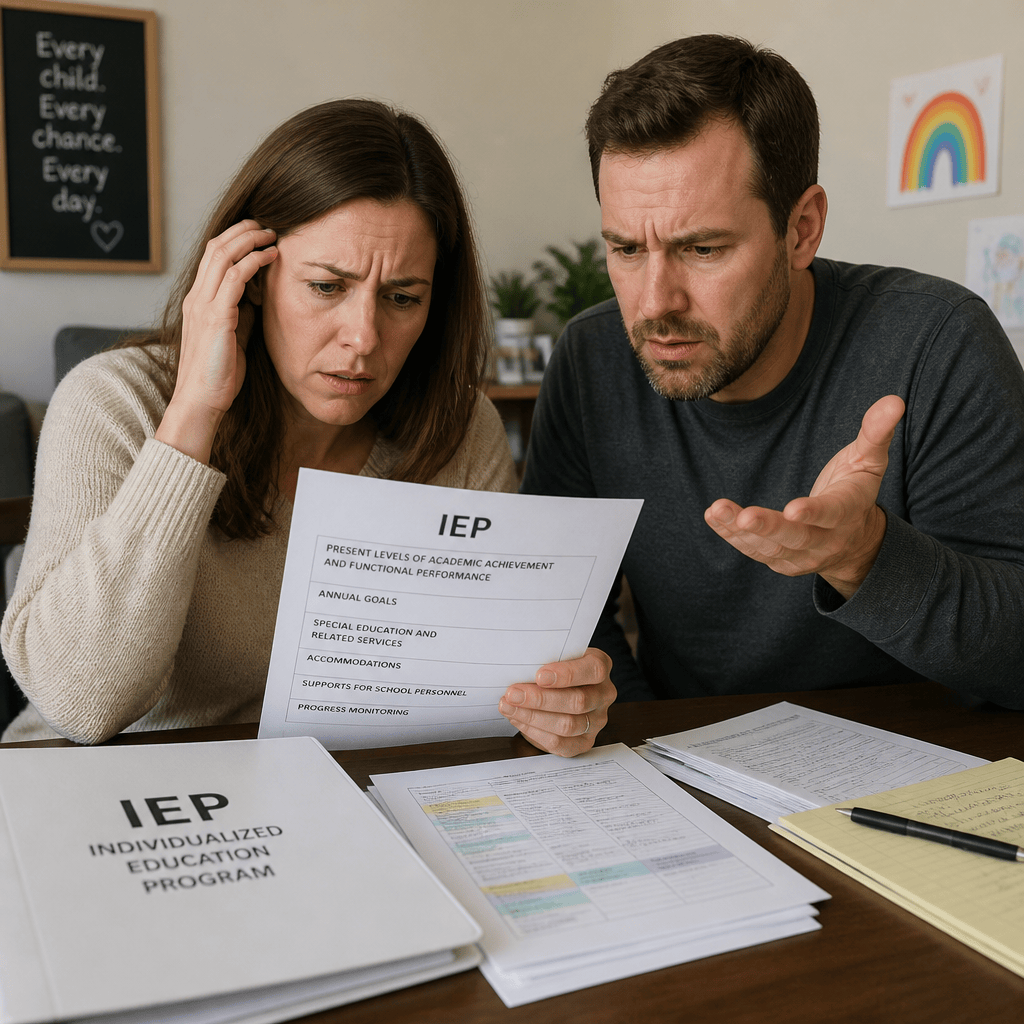
If your child has an IEP, you’ve probably received a document that contains enough acronyms, educational terminology, numbers, percentages, and legal language to make your head spin.
And then someone hands it to you and says:
“Let us know if you have any questions.”
Um…I have approximately 47 questions.
Let’s start with the most important one:
What is this document actually supposed to do?
An Individualized Education Program—or IEP—is a written plan for a child who qualifies for special education under IDEA. Federal regulations require an IEP to include, among other things, the child’s present levels of academic achievement and functional performance, measurable annual goals, how progress will be measured, special education and related services, supplementary aids and services, and other required information.
But understanding what is required and understanding how to actually read the document are two different things.
So let’s break it down.
First: An IEP Is Individualized
This sounds obvious.
But it is one of the most important things to remember.
Your child isn’t supposed to have an IEP simply because they have a particular diagnosis.
Two children with the same diagnosis can have completely different strengths, needs, goals, accommodations, services, and educational programs.
The question isn’t simply:
“What diagnosis does this child have?”
The question is:
“What does this particular child need in order to receive an appropriate education and make progress?”
IDEA requires measurable annual goals to address the child’s disability-related needs and enable the child to be involved in and make progress in the general education curriculum, as well as other educational needs resulting from the disability.
Start With Present Levels
Before you look at the goals, look at the Present Levels of Academic Achievement and Functional Performance, often called PLAAFP.
This section should tell you where your child is currently functioning.
Think of it as the starting point.
If we’re planning a road trip, we need to know where we’re starting before we decide where we’re going.
The same idea applies here.
For example:
“Student has difficulty with reading.”
That’s information.
But it’s not particularly useful by itself.
Compare it with:
“Student currently reads a third-grade passage at 52 words per minute with 85% accuracy and answers literal comprehension questions with 60% accuracy.”
Now we have data.
We know more about the starting point.
And that gives us something against which future progress can be compared.
The Connection Between Present Levels, Goals, and Services
One of the most useful ways to read an IEP is to follow the chain:
Present Level → Need → Goal → Instruction/Service → Progress Data
For example:
Present level:
Student reads 52 words per minute with 85% accuracy.
Need:
Reading fluency is affecting access to grade-level curriculum.
Goal:
Student will increase reading fluency to a specified criterion.
Service/instruction:
Specially designed reading instruction addressing the identified need.
Progress monitoring:
Regular collection of reading-fluency data.
The exact services and methods will depend on the individual student and IEP team.
The point is that the pieces should make sense together.
What Is a Measurable Annual Goal?
This is probably the most important part of this article.
IDEA requires IEPs to contain measurable annual goals, including academic and functional goals. The IEP must also describe how progress toward those goals will be measured.
A measurable goal should allow the team to determine whether the student has actually achieved the stated outcome.
In plain English:
You should be able to look at the data and answer:
Did they meet it?
The Five Parts I Look For
A useful way to examine a goal is to look for five things.
1. The Skill
What is the child supposed to do?
Examples:
- identify
- read
- calculate
- write
- request
- communicate
- initiate
- follow
- organize
- self-advocate
- transition
Be careful with vague words such as:
- improve
- understand
- increase awareness
- demonstrate progress
- do better
Those words aren’t automatically wrong, but by themselves they don’t tell you enough about what performance will actually look like.
2. The Condition
Under what circumstances will the student perform the skill?
For example:
“Given a grade-level passage…”
or
“Given a visual schedule…”
or
“During structured peer activities…”
or
“When presented with a non-preferred task…”
Conditions matter because performance can look very different depending on the environment and supports.
3. The Criterion
How well does the student have to perform?
Examples include:
- 80% accuracy
- 90% accuracy
- 4 out of 5 opportunities
- 80 words per minute
- for 10 consecutive minutes
- across three consecutive data collections
The criterion tells us what counts as success.
4. The Measurement
How are we going to know?
Possible measurements can include:
- work samples
- curriculum-based measures
- frequency counts
- duration
- accuracy
- observations
- data sheets
- assessments
- rubrics
- task-analysis data
IDEA requires the IEP to describe how progress toward annual goals will be measured.
5. The Timeframe
An annual goal is intended to address what the student is expected to accomplish over the IEP period.
The IEP should make clear what the target is and when the team will evaluate progress toward it.
Good Goal vs. Unacceptable/Vague Goal
Let’s look at some examples.
Reading
❌ Too vague:
“Johnny will improve his reading skills.”
The problem?
We don’t know:
- which reading skill
- his baseline
- how much improvement is expected
- what conditions apply
- how it will be measured
- what counts as success
✅ Much more measurable:
“Given a third-grade-level informational passage and his documented reading accommodations, Johnny will answer literal and inferential comprehension questions with at least 80% accuracy across three consecutive data collections by the annual review date.”
Now we have something we can actually monitor.
Writing
❌ Too vague:
“Emily will improve her writing.”
What does “improve” mean?
Better handwriting?
Longer writing?
Better grammar?
Organization?
Sentence construction?
Paragraph structure?
We don’t know.
✅ More measurable:
“Given a grade-level writing prompt and access to her documented accommodations, Emily will produce a paragraph containing a topic sentence, at least three relevant supporting details, and a concluding sentence in 4 of 5 collected writing samples.”
Now we can examine actual work samples.
Organization
❌ Too vague:
“Sarah will improve her organizational skills.”
✅ More measurable:
“Given a daily assignment checklist, Sarah will record assigned homework and required materials with 90% accuracy across four consecutive weeks.”
Now we can collect data.
Social Communication
❌ Too vague:
“Marcus will improve his social skills.”
✅ More measurable:
“During structured peer activities, Marcus will initiate or respond to a peer interaction using an appropriate verbal or AAC response in 4 of 5 observed opportunities across three consecutive data collections.”
The exact goal appropriate for an individual child would depend on that child’s needs and evaluation data.
Behavior
Behavior goals are another area where vague language can cause problems.
❌ Too vague:
“Johnny will improve his behavior.”
Which behavior?
When?
Why?
What replacement skill are we teaching?
How do we measure it?
A more measurable goal might look like:
✅ Example:
“Given a non-preferred academic task, Johnny will use a taught break-request strategy instead of leaving the instructional area in 4 of 5 observed opportunities across three consecutive weeks.”
Notice something important here:
We’re not simply saying “stop leaving.”
We’re identifying a replacement behavior.
That’s an important distinction.
What About “80% of the Time”?
This is one of my favorite phrases to question.
You may see:
“Student will remain seated 80% of the time.”
Okay.
80% of what?
A 30-minute class?
The entire school day?
Independent work?
A specific activity?
And how is someone calculating that 80%?
A percentage doesn’t automatically make a goal measurable.
The measurement procedure matters.
What About “4 Out of 5 Opportunities”?
This can be perfectly useful.
But again:
What is an opportunity?
If the goal says:
“Student will initiate communication in 4 out of 5 opportunities.”
I’d want to know:
- Who creates the opportunities?
- What counts as an opportunity?
- Are they naturally occurring?
- Are they structured?
- What communication counts?
- What prompts are allowed?
- How frequently is data collected?
The number alone doesn’t tell the whole story.
Prompting Matters
This is especially important for students receiving behavioral, communication, or functional support.
Consider:
“Student will complete the task with 80% accuracy with prompting.”
That sounds measurable.
But what does prompting mean?
One verbal prompt?
A visual cue?
Several verbal prompts?
Modeling?
Physical assistance?
Someone sitting beside the student?
Those aren’t necessarily equivalent.
If independence is the skill we’re trying to teach, the level and type of assistance can be extremely important to understanding the student’s actual performance.
A parent can reasonably ask:
“What level of prompting is included in this goal?”
Goals Are Not Accommodations
This distinction causes a lot of confusion.
An accommodation generally changes how a student accesses instruction or demonstrates knowledge.
Examples can include:
- extended time
- preferential seating
- text-to-speech
- breaks
- reduced-distraction environment
- directions read aloud
A goal describes a skill or outcome the student is working toward.
For example:
Accommodation:
Student receives extended time.
Goal:
Student will complete a specified written task using a specified criterion.
The accommodation supports access.
The goal describes the skill being developed.
Goals Are Not Services Either
Here’s another distinction:
“Student will receive specialized reading instruction.”
That’s a service or instructional support.
It isn’t the same thing as an annual goal.
A goal might describe what the student is expected to accomplish through instruction.
The IEP should also identify the special education and related services, supplementary aids and services, and other supports necessary for the student to advance toward the annual goals and participate in the curriculum and school activities.
Functional Goals Are Real Goals
Sometimes parents hear “IEP goals” and immediately think:
reading, writing, math.
But functional goals can be extremely important.
IDEA specifically includes academic and functional goals.
Depending on the individual child, educationally relevant functional skills might include:
- communication
- self-advocacy
- organization
- transitions
- mobility
- independence
- social communication
- daily school routines
- behavior interfering with learning
The important thing is that the goal should address an identified educational need related to the child’s disability.
What a Measurable Goal Is NOT
Here are some phrases that should make you pause and ask questions.
“Will improve…”
Improve what?
“Will understand…”
How will understanding be demonstrated?
“Will increase awareness…”
How will awareness be measured?
“Will make progress…”
How much progress?
“Will do better…”
According to what measurement?
“Will demonstrate appropriate behavior…”
What behavior?
“Will be more independent…”
What does independent mean?
“Will participate…”
How much participation?
“Will use appropriate social skills…”
Which social skills?
None of these phrases automatically make an IEP unlawful or inappropriate simply because they appear in a document.
The issue is whether the goal as a whole is sufficiently measurable and connected to the child’s needs.
The Goal Does Not Have to Use One Magic Formula
You may have heard that every IEP goal has to follow a particular formula.
You may also have heard:
“It has to be SMART.”
SMART goals can be a helpful framework.
But IDEA does not require every IEP goal to follow one specific federally mandated template or use one particular assessment tool. Federal regulations require measurable annual goals and require the IEP to describe how progress toward those goals will be measured.
So don’t get distracted by whether the goal uses the “perfect” formula.
Ask the more important question:
Can we objectively determine whether the child achieved this goal?
Progress Reports: Don’t Ignore Them
Another important piece of the IEP is progress monitoring.
The IEP must state:
- how progress toward annual goals will be measured, and
- when periodic progress reports will be provided.
So when you receive a progress report that says:
“Johnny is making progress toward his goal.”
You can ask:
“What data support that statement?”
For example:
- What was his baseline?
- What is his current performance?
- What was the most recent data collection?
- Is he on track to meet the annual goal?
- What percentage or frequency is he currently demonstrating?
- What level of support is required?
The goal of progress monitoring isn’t to create paperwork.
It’s to determine whether the educational program is actually producing progress.
What If My Child Isn’t Making Progress?
This is where good data become incredibly valuable.
If the student isn’t making expected progress, the team has something concrete to discuss.
Maybe:
- the instructional approach needs to change;
- the goal needs to be reconsidered;
- the baseline wasn’t accurate;
- the intervention isn’t effective;
- the student needs additional support;
- the student needs additional evaluation;
- there are barriers affecting access to instruction.
A lack of progress shouldn’t simply become:
“We’ll try again next year.”
The data should inform the conversation.
Questions to Take Into Your Next IEP Meeting
You don’t need to memorize IDEA.
Put these questions in your phone.
About Present Levels
“What data are we using to describe my child’s current performance?”
About the Goal
“What specifically is my child expected to do?”
About the Baseline
“Where is my child starting?”
About Measurement
“How will we measure this?”
About Prompting
“What level of prompting or assistance is allowed?”
About Criteria
“What exactly counts as meeting the goal?”
About Progress
“How frequently will data be collected?”
About Progress Reports
“What information will I receive in the progress report?”
About Services
“What instruction or service is being provided to address this goal?”
And my favorite:
“How will we know when this goal has been met?”
If everyone can answer that question clearly, you’re probably having a much more productive conversation.
A Simple Way to Read an IEP
If the entire document feels overwhelming, start here:
1. Where is my child now?
Look at Present Levels.
2. What are the disability-related educational needs?
Look at the evaluation information and present levels.
3. Where are we trying to go?
Look at the annual goals.
4. How are we going to get there?
Look at special education, related services, supplementary aids, accommodations, modifications, and other supports.
5. How will we know whether we’re getting there?
Look at the progress-monitoring method and progress reports.
That’s the basic roadmap.
One Last Thing
You don’t have to become an expert overnight.
I say this as a parent:
The first time IEP language looks like another language, you’re not failing.
It’s complicated.
There are educational terms, legal requirements, assessments, services, accommodations, goals, data, and a whole lot of acronyms.
You are allowed to ask questions.
You are allowed to ask someone to explain something.
You are allowed to say:
“I don’t understand that.”
And you are absolutely allowed to ask:
“Can you show me the data?”
Because understanding your child’s IEP isn’t about becoming difficult.
It’s about becoming an informed member of the team.
And honestly?
You don’t need to walk into the meeting knowing everything.
Start with three questions:
Where is my child now?
Where are we trying to get them?
How will we know if we’re getting there?
Those three questions can tell you a lot.
A Note About This Article
This article is intended for general educational information and isn’t legal advice. IDEA is federal law, but state requirements, procedures, and district practices can differ. For a specific dispute or legal question, consider consulting your state’s special education resources or a qualified special education attorney/advocate.
Sources
The U.S. Department of Education’s IDEA regulations define the required components of an IEP, including present levels, measurable annual goals, progress measurement, services, supports, and other required elements.
The federal regulation specifically addressing measurable annual goals is 34 CFR §300.320(a)(2).
The regulation addressing measurement and reporting of progress is 34 CFR §300.320(a)(3).
This channel provides educational and informational content based on personal experience, professional experience, and research. It is not medical, legal, educational, or behavioral-health advice. Laws, regulations, policies, and services vary by state and individual circumstances. Always consult the appropriate qualified professional or agency for advice regarding your specific situation.


Leave a Reply