
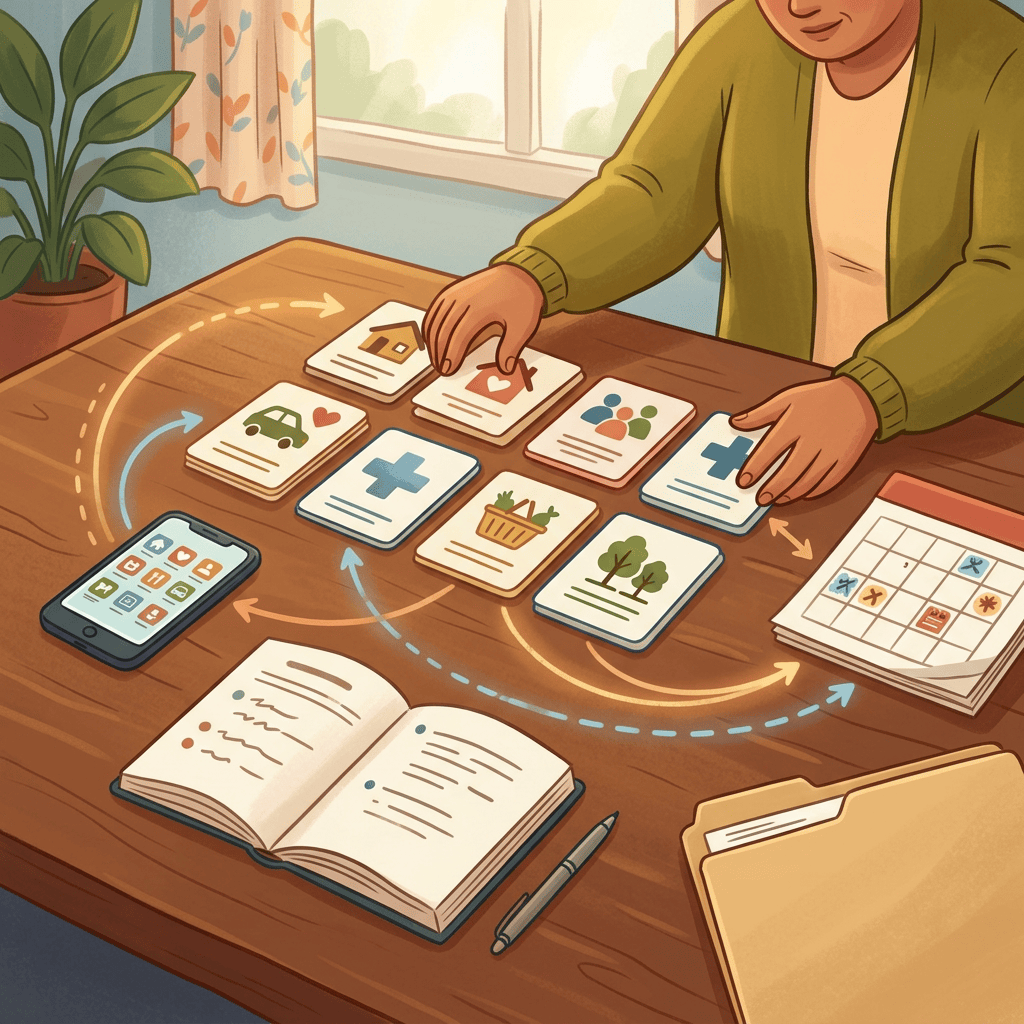
A general guide for finding help when you’re the person everyone depends on
Let’s talk about something caregivers are really good at:
Doing everything ourselves.
Not because we necessarily want to.
Because sometimes we don’t know what else to do.
Someone needs an appointment.
Someone needs transportation.
Someone needs help bathing.
Someone needs medication.
Someone needs a ride.
Someone needs food.
Someone needs paperwork.
Someone needs supervision.
Someone needs an advocate.
Someone needs you.
So you do it.
And then you do it again tomorrow.
And eventually someone says:
“You should look into caregiver resources.”
Okay.
Where?
What resources?
Who qualifies?
Who do I call?
Is there a waiting list?
Does it cost money?
Is this for me or the person I’m caring for?
And why does finding help sometimes feel like you need a full-time job to find the people who are supposed to help you?
Welcome to caregiving.
First: What Counts as a Caregiver?
You don’t have to have a special title.
You might be a:
- Parent
- Spouse
- Adult child
- Grandparent
- Sibling
- Family member
- Friend
- Foster caregiver
- Unpaid support person
You might be caring for someone with:
- A disability
- Autism
- Intellectual or developmental disabilities
- A mental health condition
- A chronic illness
- A physical disability
- Dementia
- An injury
- Complex medical needs
- Aging-related needs
You may even be caring for someone who technically can do many things independently but needs significant help coordinating life.
Caregiving doesn’t always look like lifting someone out of bed.
Sometimes caregiving looks like spending three hours on the phone trying to get an insurance problem fixed.
Sometimes it looks like filling out applications.
Sometimes it looks like making sure everyone else knows what the person needs.
Sometimes it looks like being the person who remembers everything.
That is still caregiving.
Start With the Person’s Needs
Before searching for programs, make a list of what you actually need help with.
Not what you think you should need help with.
What you actually need.
Try categories like:
🏠 Home
- Personal care
- Meal preparation
- Housekeeping
- Safety
- Equipment
- Home modifications
🏥 Medical
- Transportation
- Appointments
- Medication management
- Medical equipment
- Home health
- Care coordination
🧠 Behavioral or Mental Health
- Counseling
- Crisis support
- Behavioral services
- Respite
- Community-based services
🎓 Education
For children:
- Early intervention
- Special education
- IEP support
- Related services
- School transportation
- Advocacy
💼 Employment
For older teens and adults:
- Job training
- Vocational rehabilitation
- Supported employment
- Job coaching
- Workplace accommodations
🚗 Transportation
- Medical transportation
- Public transportation assistance
- Paratransit
- Transportation to work or activities
💰 Financial
- Benefits
- Food assistance
- Housing assistance
- Utility assistance
- Disability benefits
- Tax-related programs
- Legal/financial planning
🧑🤝🧑 Social & Community
- Recreation
- Day programs
- Community activities
- Disability organizations
- Support groups
🛌 Respite
And please don’t skip this one.
Respite means someone else helps provide care so the caregiver can have a break.
A break is not a luxury.
A break is part of keeping the caregiving arrangement sustainable.
Start Local
One of the biggest mistakes caregivers can make is searching the entire internet for everything at once.
Start closer to home.
Depending on your situation, that might mean:
- Your county
- Your city
- Your state’s aging or disability agency
- Your local Area Agency on Aging
- Community mental health services
- Disability organizations
- Your child’s school
- Your healthcare system
- Your insurance company
- Local nonprofits
And don’t be afraid to ask:
“Is there a caregiver program in my area?”
Sometimes the hardest part isn’t finding a service.
It’s knowing the service exists.
Area Agencies on Aging
If you’re caring for an older adult, your local Area Agency on Aging can be an important starting point.
These agencies may connect older adults and caregivers with services such as:
- Information and referral
- Meals
- Transportation
- Caregiver support
- Respite resources
- In-home services
- Support programs
Services vary by location and eligibility.
But if you’re caring for an older adult and don’t know where to begin, finding your local Area Agency on Aging is a good place to start.
Aging and Disability Resource Centers
You may also encounter Aging and Disability Resource Centers, sometimes called ADRCs.
The idea is pretty simple:
You shouldn’t have to call twenty different agencies to figure out which agency you need.
ADRCs and similar information-and-referral systems can help people identify available long-term services and supports.
Availability and structure vary by state.
So if you see the term ADRC, don’t skip over it because it sounds like another government acronym.
It may be exactly what you’re looking for.
211
If you don’t know where to start, 211 can be a surprisingly useful starting point in the United States.
You can use 211 to look for local resources involving things such as:
- Food
- Housing
- Utilities
- Transportation
- Healthcare
- Caregiver support
- Community programs
The exact resources available depend on your location.
You don’t have to know the name of the program before calling.
You can essentially say:
“I’m caring for someone and I need help figuring out what resources are available.”
That’s a perfectly reasonable place to start.
Your Healthcare Team
Your doctor may not know every community resource.
But they may know where to send you.
Ask about:
- Social workers
- Care managers
- Patient navigators
- Behavioral health services
- Home health
- Community programs
- Medical equipment
- Transportation resources
If you’re dealing with a hospital or healthcare system, ask whether they have a social worker or care coordinator who works with families.
And remember:
You don’t have to wait until you’re completely overwhelmed to ask.
Your Insurance Company
Insurance can be frustrating.
I don’t think anyone is going to argue with me about that.
But your insurance company may have resources that caregivers don’t realize exist.
Ask about:
- Care management
- Case management
- Transportation
- Durable medical equipment
- Home health benefits
- Behavioral health
- Therapy
- In-home services
- Caregiver support benefits
- Disease-specific programs
And here’s an important question:
“Are there services available through my plan that I haven’t been using?”
Sometimes the answer is yes.
Medicaid and Other Public Benefits
Depending on the person’s age, disability, income, and circumstances, Medicaid and other public programs may provide access to services that aren’t available through ordinary health insurance.
These can include things such as:
- Personal care
- Home and community-based services
- Medical equipment
- Transportation
- Behavioral health services
- Long-term supports
Eligibility and programs vary considerably by state.
This is one of those areas where you may need to ask:
“What programs exist in my state for someone with these needs?”
Don’t assume that because someone was denied one program, they’re automatically ineligible for everything else.
Respite: The Resource Caregivers Forget
Let’s talk about respite again.
Because caregivers sometimes put themselves at the bottom of the list.
Respite can take different forms.
It might be:
- Someone coming into the home
- A short-term program
- A community activity
- A trained caregiver
- A family support program
- A camp
- A temporary care arrangement
Not every respite program is free.
Not every program serves every diagnosis or age.
And some have waiting lists.
But ask anyway.
Because you cannot pour from an empty cup.
And yes, I know that’s an incredibly overused saying.
It’s still true.
Support Groups Aren’t Just for Complaining
Okay.
They can absolutely be for complaining.
Sometimes you need that too.
But caregiver support groups can also be an incredible source of information.
The person sitting next to you may know:
- Which agency actually returns calls
- Which program has a waiting list
- Which form you need
- Who to contact
- What questions to ask
- What resource you didn’t know existed
Sometimes another caregiver can explain a complicated system in five minutes because they’ve already spent six months figuring it out.
Just remember that other caregivers’ experiences aren’t necessarily official eligibility or legal advice.
Use the information as a lead.
Then verify it.
Don’t Forget Your Own Healthcare
This one gets ignored constantly.
The caregiver is also a person.
You need:
- Your own doctor
- Your own medications
- Sleep
- Food
- Mental health support
- Social connection
- Time away from caregiving when possible
And you need someone who knows what happens to the person you’re caring for if you get sick.
That’s not pessimistic.
That’s planning.
Ask:
“What happens if I can’t provide care tomorrow?”
That’s an important question.
Create a Caregiver Emergency Plan
If you’re the person who knows everything, someone else needs to know at least some of it.
Consider creating a simple document with:
- Important contacts
- Medications
- Doctors
- Diagnoses
- Allergies
- Daily routines
- Communication needs
- Emergency information
- Insurance information
- Equipment information
- Preferred hospital
- Important behavioral/safety information
- Where important documents are located
You don’t need to write a 75-page autobiography.
Start with the information someone would need if they suddenly had to step in.
Keep a Resource List
Once you start finding resources, keep them somewhere.
Create a simple list:
| Resource | What They Provide | Contact | Application | Follow-Up |
|---|---|---|---|---|
| Agency | Respite | Phone/email | Submitted | Oct. 15 |
| Insurance | Care management | Phone | Requested | Sept. 30 |
| Local nonprofit | Transportation | Phone | Pending | Oct. 2 |
Because otherwise you will spend three months searching for the same phone number you found at 2:00 a.m. on a Tuesday.
Ask me how I know.
Actually…
Don’t.
Waiting Lists Are a Resource Too
Okay, this sounds weird.
But if a program has a waiting list, get on the list if the program might eventually be useful.
Don’t assume:
“We don’t need it today, so we won’t apply.”
Needs change.
Families change.
People age.
Caregivers get older.
Employment changes.
Medical situations change.
And some programs take time.
You can always reevaluate later.
You Don’t Have to Accept “No” as the End of the Conversation
Sometimes “no” means:
No, you don’t qualify for this program.
Sometimes it means:
No, we’re full.
Sometimes it means:
No, we don’t provide that service.
Sometimes it means:
No, that’s not our department.
And sometimes…
it means someone didn’t understand what you were asking.
So when you hear no, try:
“Is there another program that might provide this?”
or:
“Who would be the right person to ask?”
or:
“Can you give me a referral?”
You don’t have to argue.
You’re just continuing the search.
You Are Allowed to Ask for Help Before You’re Desperate
This may be my biggest message for caregivers.
You don’t have to wait until everything is falling apart.
You don’t have to prove that you’re exhausted enough.
You don’t have to reach a crisis before you’re allowed to ask about respite.
You don’t have to be completely overwhelmed before you ask for care coordination.
You don’t have to wait until you can’t do one more thing.
Ask early.
Because getting connected to a resource can take time.
Your Caregiver Resource Checklist
If you’re not sure where to start, try this:
1. Write down the biggest three things you need help with.
Not 37 things.
Three.
2. Call 211 or your local information-and-referral service.
Ask what is available in your area.
3. Ask your healthcare team about social work or care coordination.
4. Contact your insurance company.
Ask about care management and caregiver benefits.
5. Look for your local aging/disability resource system.
6. Ask about respite.
7. Look for caregiver support groups.
8. Get on appropriate waiting lists.
9. Make an emergency care plan.
10. Keep everything in one place.
And most importantly:
Don’t assume that because you haven’t found help yet, help doesn’t exist.
Sometimes the resource is there.
You just haven’t found the right door.
The Caregiver Isn’t the Backup Plan
Here’s what I want caregivers to remember.
You are important.
Your knowledge matters.
Your advocacy matters.
Your relationship with the person you’re caring for matters.
But you are not an infinite resource.
You shouldn’t have to be the entire healthcare system.
The entire transportation department.
The entire benefits office.
The entire educational system.
The entire behavioral support team.
And the entire emergency backup plan.
You’re a caregiver.
You’re also a human being.
So look for the resources.
Ask the questions.
Make the calls.
Get on the waiting lists.
Build your team.
And when someone says:
“Let me know if you need anything.”
Maybe, for once, believe them.
Tell them exactly what you need.
Because sometimes the most important caregiver resource isn’t another form.
It’s another person.

 Palace in Underland
Leave a comment