
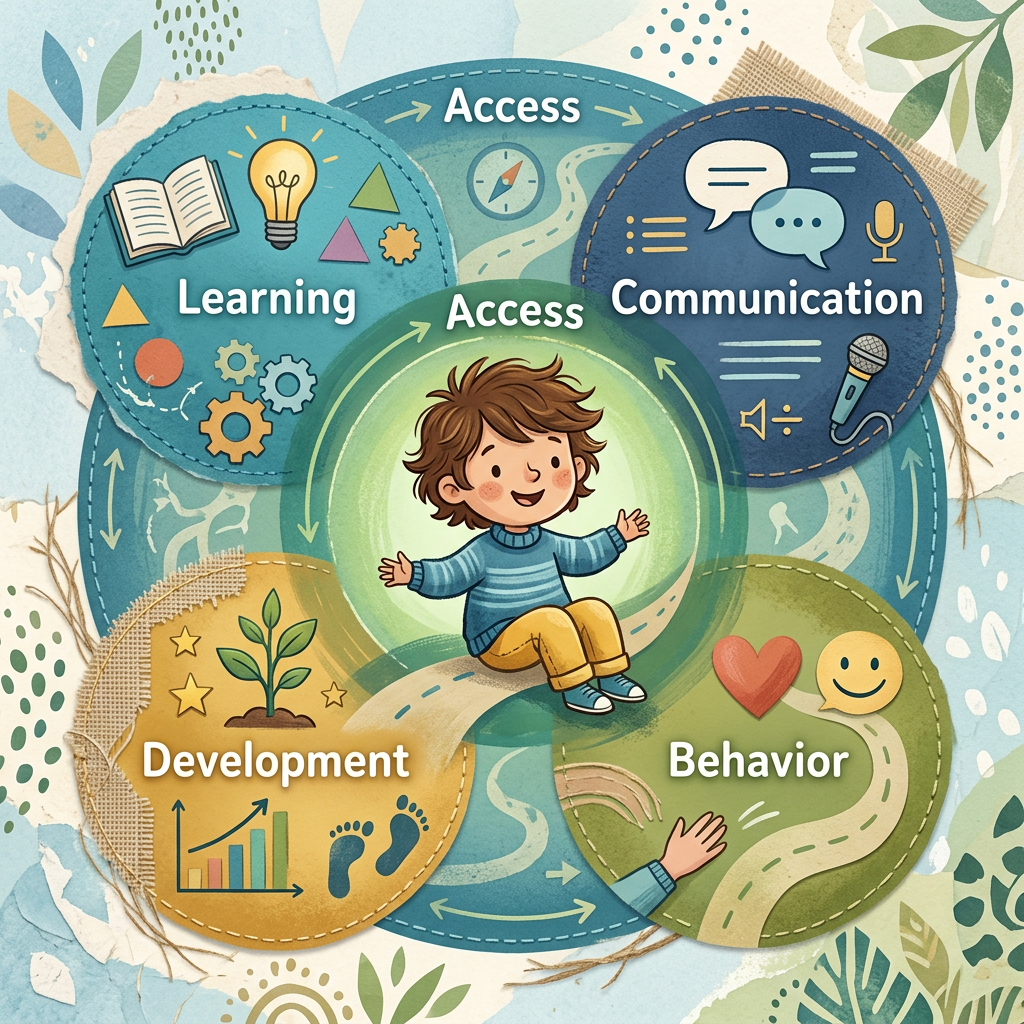
Special education eligibility is generally determined through a comprehensive evaluation—not one single test. The school is looking at multiple sources of information to determine:
- Whether the child has a disability category recognized under IDEA.
- How that disability affects the child’s educational performance.
- Whether the child needs specially designed instruction and/or related services.
Common types of assessments
| Assessment | What it looks at | Examples |
|---|---|---|
| Cognitive / intellectual testing | Thinking, reasoning, memory, processing | WISC, WPPSI, DAS |
| Academic achievement testing | Reading, writing, math, academic skills | WIAT, Woodcock-Johnson, KTEA |
| Psychological testing | Emotional/behavioral functioning and psychological factors | Rating scales, clinical interviews, observations |
| Behavior rating scales | Behavior, attention, emotional regulation, social skills | BASC, Conners, Vineland |
| Adaptive behavior testing | How independently a child functions in everyday life | Vineland, ABAS |
| Speech/language evaluation | Understanding and using language, articulation, communication | CELF, GFTA and other language measures |
| Occupational therapy evaluation | Fine motor, sensory, visual-motor, functional school skills | OT assessment tools + observation |
| Physical therapy evaluation | Gross motor skills, mobility, physical access | PT assessment + functional observation |
| Functional Behavioral Assessment (FBA) | Why a behavior is happening and what maintains it | ABC data, interviews, observations |
| Autism-specific assessments | Social communication, restricted/repetitive behaviors, developmental characteristics | ADOS-2, ADI-R, rating scales |
| Assistive technology evaluation | Whether technology is needed to access education | Communication devices, writing/reading technology, etc. |
| Vision/hearing screening or evaluation | Whether sensory impairment may affect school performance | Screening and/or specialist evaluation |
And here’s the part parents really need to know:
A test score by itself doesn’t determine eligibility.
For example, a child can have an average IQ and still qualify for special education because of a significant learning disability, autism, emotional impairment, speech/language impairment, or another qualifying disability.
Likewise, a child can have a low score on an assessment and not automatically qualify for an IEP.
The school should consider the evaluation results along with other information, such as:
- Classroom performance
- Teacher observations
- Parent input
- Developmental history
- Medical information when relevant
- Work samples
- Grades
- Attendance
- Behavior data
- Previous interventions
- Progress-monitoring data
- Classroom observations
- How the child’s disability affects access to and progress in education
There are different kinds of evaluations for different questions.
For example:
“Can my child read at grade level?” → academic achievement testing.
“How does my child learn and process information?” → cognitive/psychological assessment.
“Why is my child hitting, running away, or refusing work?” → potentially an FBA.
“Can my child communicate effectively at school?” → speech/language evaluation.
“Can my child independently manage everyday school activities?” → adaptive behavior assessment.
And sometimes several of these are needed together.
Also: parents can request an evaluation
A parent does not have to wait for a teacher to say, “I think we should test.”
Under IDEA, parents can request an evaluation when they suspect their child may have a disability and need special education services. The exact evaluation/consent/timeline procedures are governed by federal and state requirements.
And this is where I’d add one of your recurring Palace in Underland messages:
Don’t just ask, “What test are you giving my child?”
Ask:
- What areas are you evaluating?
- What disability are you considering?
- What assessments will be used?
- Who will conduct each evaluation?
- What information are you using besides standardized testing?
- How will you determine whether my child’s disability affects their education?
- What happens if the testing doesn’t capture what we’re seeing at home or school?
- Can I provide outside evaluations or medical/developmental information?
And importantly, the school doesn’t necessarily have to use the exact test a parent requests, but the evaluation should be sufficiently comprehensive to identify the child’s special education and related-service needs.


Leave a Reply